
Project At-a-Glance
- Replacement of an existing 115kV overhead transmission crossing with two parallel power cables installed beneath the Rappahannock River
- The 1.9-mile-wide river crossing was installed using Horizontal Directional Drilling (HDD)
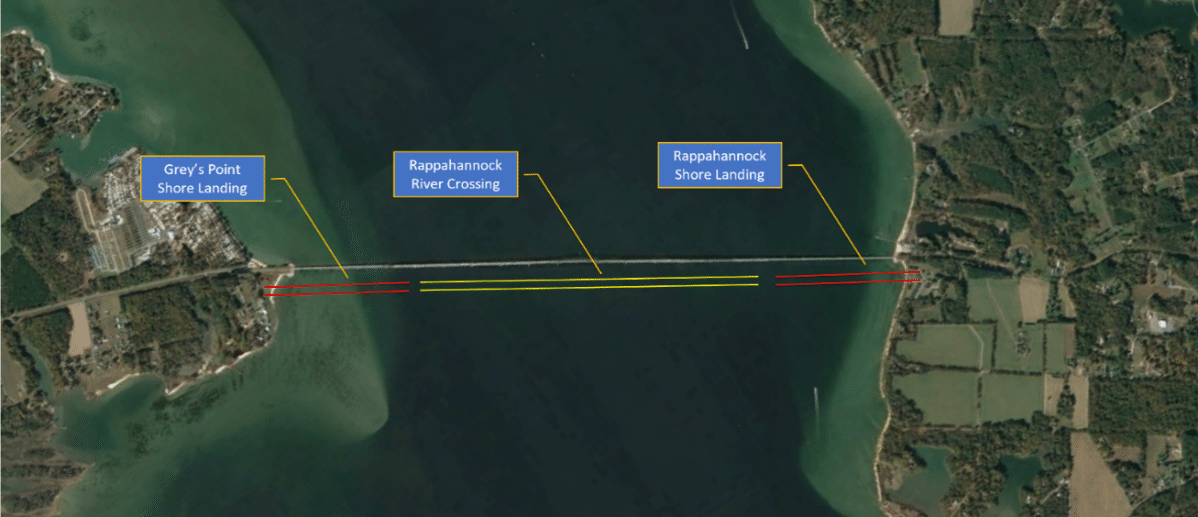
- The project included six parallel bores: two 2,700-ft shore to landing bores at Grey’s Point, two 6,650-ft river crossing bores, and two 2,500-ft shore to landing bores on the Rappahannock side
- Completed through intersect drilling using two separate marine platforms and land-based rigs
Recognition
- Trenchless Technology Magazine Project of the Year-New Installations-2021
Dominion Energy Virgnia planned to replace an existing 115kV overhead transmission line crossing the Rappahannock River near White Stone, VA with two new parallel power cables beneath the river bed. The new installation is where the Rappahanock River is 1.9-mile wide and is located parallel to the Norris Bridge. To reduce surface and riverbed disturbance, the installation was completed by Horizontal Directional Drilling (HDD).
Brierley Associates teamed with Mears Group and POWER Engineers in an EPC (Engineer-Procure-Construct) arrangement and served as the designer and Engineer-of-Record for the HDD installations. These included six separate, parallel bores:
- Grey’s Point Shore Landing (land to water): 2 bores at 2,700-ft each
- Rappahannock River Crossing (water to water): 2 bores at 6,650-ft each
- Rappahannock Shore Landing (land to water): 2 bores at 2,500-ft each
Each bore was designed to contain an 8.625-in OD steel pipe and a plastic conduit for fiber cable. The bores were separated by approximately 20-ft horizontally.
Brierley Associates developed HDD plan and profile drawings for three parallel crossings of electric and fiber conduit pipes, entry and exit site plans, cross sections at selected locations, details of splice locations in river. Brierley also characterized the geotechnical conditions, and prepared detailed hydrofracture analyses. In addition, we completed pipe pull load and pipe stress calculations for each of the installations. We also assisted Mears with the procedure, analysis and engineering for the pipe overboarding process.
The Rappahannock River Crossing was completed through intersect drilling using two separate marine platforms and the shore landings were completed with land-based rigs.
Related Projects