
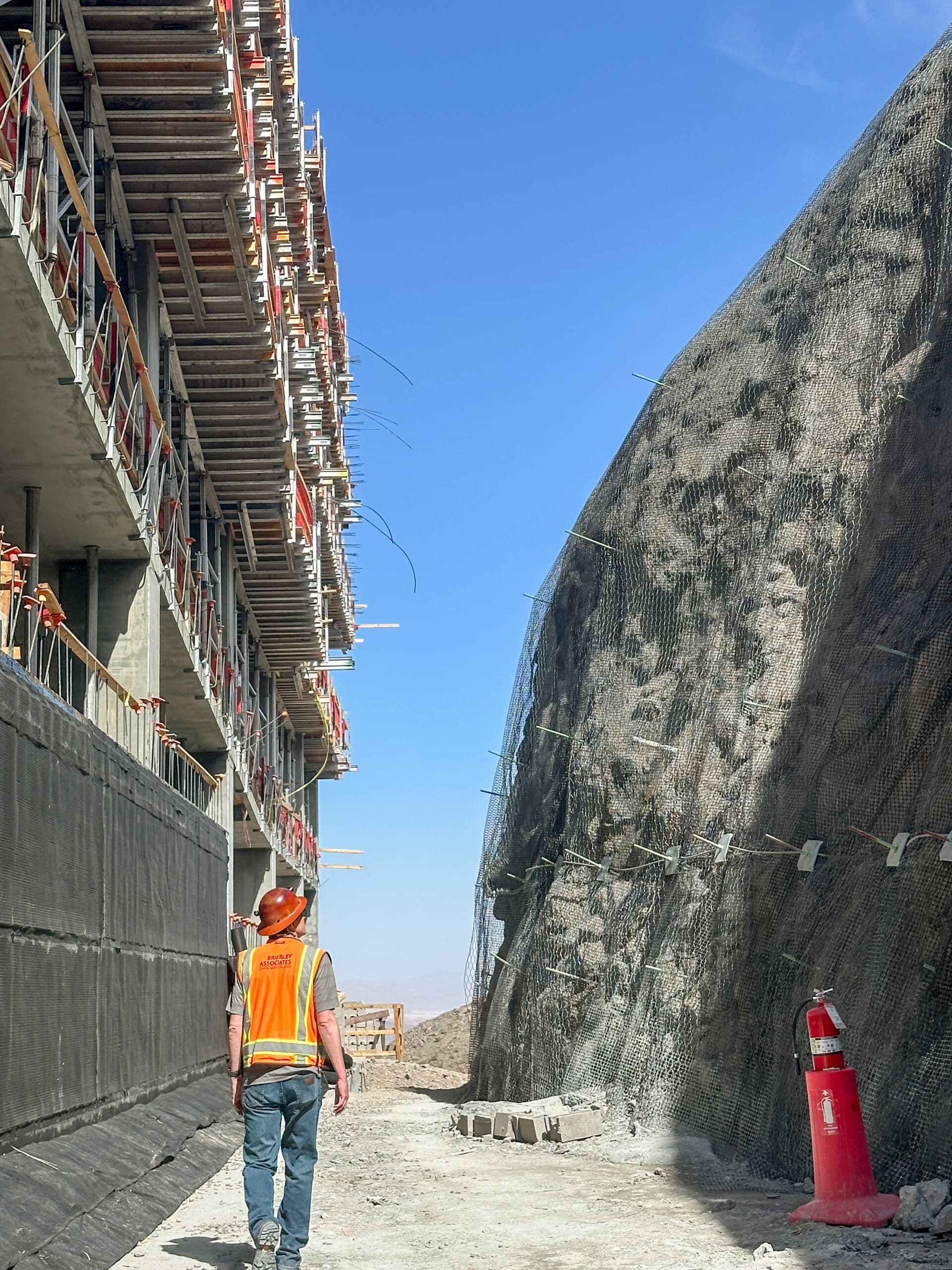
 When overblasting during excavation left two high-rise towers in Henderson, Nevada, with slopes flatter than designed and gaps up to 75 feet deep between bedrock and structure, the engineering team faced a critical choice: redesign the towers or find a smarter path forward. They chose the latter.
The Pinnacle, a Four Seasons Private Residences development consisting of 24- and 25-story towers, sits on a hillside with 300 feet of vertical relief. The site’s geology, interbedded volcanic andesite and weakly cemented pyroclastic flow deposits, made excavation unpredictable. Initial drill-and-blast operations produced “overbreak,” creating irregular slope faces and large build-back zones that conventional fill could not address.
Conventional soil fill was evaluated and rejected. On a seismically active site, the weight of traditional backfill would have imposed unacceptable lateral loads on the tower foundations, requiring a costly and time-consuming structural redesign. Instead, the team turned to low-density cellular concrete (LCC), a lightweight, self-compacting material with a high strength-to-weight ratio.
The results were significant. LCC reduced backfill loads by approximately 60 to 70 percent compared to conventional soil alternatives, allowing the team to rebuild up to 75 feet of lost grade without altering the towers’ structural systems. Placed in two-foot lifts using wire baskets and geotextiles, the LCC filled the overbreak zones efficiently and with a high degree of field adaptability.
Lightweight fill alone, however, was not sufficient. The design also integrated rock dowels, using No. 7 Grade 75 all-threaded bars, to transfer lateral seismic loads from the LCC mass into competent bedrock. Verification and proof testing confirmed that anchors achieved the required bond capacity even within the weaker pyroclastic deposits. A compressible void form placed between the LCC block and the foundation walls allowed the fill mass to deflect during a seismic event without transmitting damaging forces to the building structure.
The combined system of lightweight fill and anchorage with field-adapted observations, delivered measurable cost and schedule benefits by avoiding a full structural redesign. It also demonstrated something broader: that performance-based geotechnical engineering, when paired with adaptive material selection, can resolve highly irregular site conditions without defaulting to conventional and often costlier solutions.
The approach developed at The Pinnacle offers a transferable model for high-rise development on geologically complex or steep terrain. As urban development continues to push into more challenging topographies, the integration of LCC with engineered anchorage systems represents a practical, repeatable strategy for managing excavation risk and protecting structural performance.
This project will be presented by co-author Kyle Friedman, PE, at the ASCE/CAGE Rocky Mountain Geoconference 2026 in Denver, Colorado, on November 6, 2026. The paper was authored by Kyle Friedman, PE, and Doandy Wibisono, PhD, PE, of Brierley Associates and Joseph Vaupel, EIT of Harrison Western Construction Corporation.